
The companies that win won’t be the ones “using ChatGPT occasionally.” They’ll be the ones restructuring engineering culture around AI-first development. Most companies are experimenting with AI. Very few are redesigning their SDLC around it. At HeapTrace Technology, we believe AI is not a feature — it’s a force multiplier embedded across the engineering lifecycle. AI amplifies human capability,eliminating repetitive work while empowering engineers:
1. Eliminate Low-Leverage Work
AI handles the repetitive 30%.
2. 10X Engineering Teams
Exponential productivity gains.
3. Redesign Your SDLC
Full lifecycle transformation.
4. Force Multiplier Effect
End-to-end AI integration.
Tools like OpenAI, GitHub Copilot, and enterprise LLM frameworks
✅ AI should not sit outside your workflow.
✅ It should be embedded inside your SDLC
Below is comparison of traditional and AI-powered development
• Time-to-market by 30–50%
• Manual testing overhead
• Documentation delays
• Technical debt accumulation
At HeapTrace Technology, we focus on 5 transformation pillars:
LLMs convert BRDs into tech specs and user stories
AI helps generate base structures and refactor code
AI detects vulnerabilities and generates test scaffolding
AI accelerates audit readiness for US & EU enterprises
AI is embedded into products for intelligence and automation
Below is a simplified enterprise AI integration stack
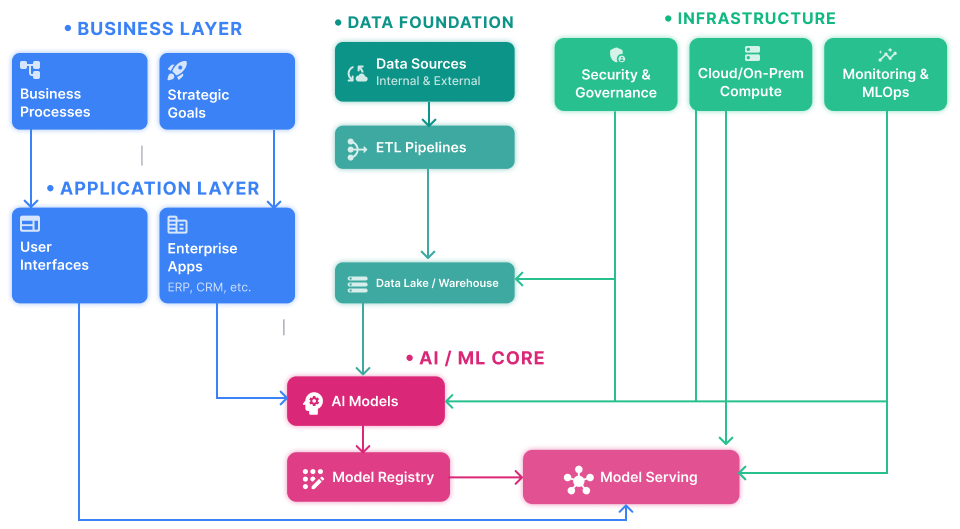
• Structured DBs
• Data lakes
• Streaming sources
• Enterprise APIs
• Prompt orchestration
• Model APIs
• Fine-tuned models
• Embedding pipelines
• SaaS dashboards
• Microservices
• REST/GraphQL APIs
• Role-based access
• Audit logs
• Compliance automation
• Model monitoring
Below is what an AI-embedded SDLC looks like:
✅ Identify repetitive engineering tasks
✅ Assess compliance documentation load
✅ Map current SDLC bottlenecks
✅ Deploy AI in code review
✅ Automate unit test generation
✅ Implement AI-assisted documentation
✅ Embed AI in CI/CD pipelines
✅ Build AI-driven QA workflows
✅ Introduce AI architecture advisors
✅ Identify repetitive engineering tasks
✅ Feasibility Study
✅ Use-Case Backlog
What to follow and what to avoid in enterprise AI
Make AI a long-term, impact-driven transformation.
Enable teams to write clear, outcome-focused prompts.
Set policies early to manage risk at scale.
Continuously validate outputs for accuracy and bias.
Tie AI to revenue, cost savings, and efficiency—track metrics to guide scaling.
Avoid unregulated tools that risk data leakage.
Protect confidential data with strict safeguards.
Ensure AI meets legal and regulatory standards.
Always validate AI results before use.
Avoid siloed tools; design for scale and integration.
Before saying “We’re AI-ready,” ask
If 4+ boxes are unchecked — you’re experimenting, not transforming.
AI is not a shortcut. It’s an infrastructure upgrade.
AI will replace 30% of traditional coding. But developers who know how to use AI will not be replaced
They will become more powerful.


